
You can also read about the Indira Gandhi Assassination Case, the Parliament Attack Case, the Red Fort Attack Case, the Jessica Lal Murder Case, the Decriminalisation of Homosexuality Case among others.

'Digital courts will alleviate congestion in traditional courts.'

Strict screening protocols are to be implemented for passengers arriving from central African countries affected by the outbreak.

Lawyers flooded the courtroom of Chief Justice of India D Y Chandrachud to witness the proceedings as one special guest -- Aamir Khan -- was seated in the front row.

New Delhi-based pharmaceutical major Mankind Pharma is poised to take pole position in women's health portfolio in the India Pharma Market (IPM) after completing the Rs 13,630 crore deal to acquire Bharat Serums and Vaccines (BSV), senior company officials said. The deal potentially opens doors for Mankind Pharma to the overseas markets, which currently draws 92 per cent of its revenues from India. The combined entity will draw around 13 per cent revenues from the international market, with the remaining coming from the domestic market.

Karnataka has the highest number of medical seats in the country at 11,745, of which 3,750 seats were in government institutions and 7,995 seats were in private colleges.

'Corporations that were recruiting 15 or 20 [students] have reduced the number to two or three.'
'Patients under the scheme may ultimately have to go to private hospitals.'

'The NEET-PG is the only exam for admission to MD, MS and PG Diploma courses.' 'Many doctors take time off from work to prepare for it, while others study during their long hospital shifts.'

Ayush refers to the six Indian systems of medicines, namely Ayurveda, Yoga and Naturopathy, Unani, Siddha, Sowa-Rigpa and Homeopathy are majorly prevalent in the country.

The move to expand the health insurance scheme's coverage comes at a time when several hospitals have complained of delays in reimbursement related to the procedures performed under the scheme.
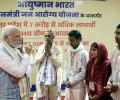
The Centre is considering a proposal on increasing coverage under the Ayushman Bharat scheme to Rs 10 lakh from the current Rs 5 lakh.

'Our priority remains brownfield expansion, and in the next few years, we plan to increase our capacity to around 6,000 beds.'

'Business families like the Godrej group are increasingly realising that an amicable settlement is better.' 'Else, the wealth of all shareholders gets destroyed.'

The Delhi high court on Friday directed the civil aviation regulator to deregister planes leased to Go First within five working days, giving respite to the lessors. This means that the airline will have to give back all 54 aircraft to the lessors if its resolution professional (RP) does not challenge the order or ask for a stay. Justice Tara Vitasta Ganju also refused the request of the RP, represented by advocate Diwakar Maheshwari, to keep the operation of the order in abeyance for a week to enable them to file an appeal before the division Bench of the court.

'As a platform, we are saying, if we are told to break encryption, then WhatsApp goes.'

Battling the virus, enduring separation from loved ones, and working extended hours became part of the job.

Enquiries indicate it belongs to an industrialist with links to a prominent cricketer.

Given the gap between budgetary allocation and use, a parliamentary standing committee has asked the Ministry of Ayurveda, Yoga and Naturopathy, Unani, Siddha and Homeopathy (Ayush) to take steps to prevent underutilisation of funds under the National Ayush Mission (NAM) scheme. According to the data, the ministry was allocated Rs 1,200 crore for the mission in the Budgetary Estimate (BE) for FY24. The Revised Estimate (RE) for the year fell to Rs 815 crore, of which Rs 589 crore, or 74 per cent, has been spent till January.

A notification of the revised Schedule M rules by the Ministry of Health and Family Welfare has elicited mixed responses from the pharma sector and industry observers. While the industry has welcomed the revision of rules, several analysts said that implementation and compliance can become a challenge for smaller pharmaceutical companies. The Schedule M of the Drugs and Cosmetics Rules specifies the good manufacturing practices (GMPs), which aim to ensure quality of drugs made in the country.
 © 2026 Rediff.com - Advertise with us - Disclaimer - Privacy Policy - Sitemap - Feedback - About us - Terms of use - Grievances